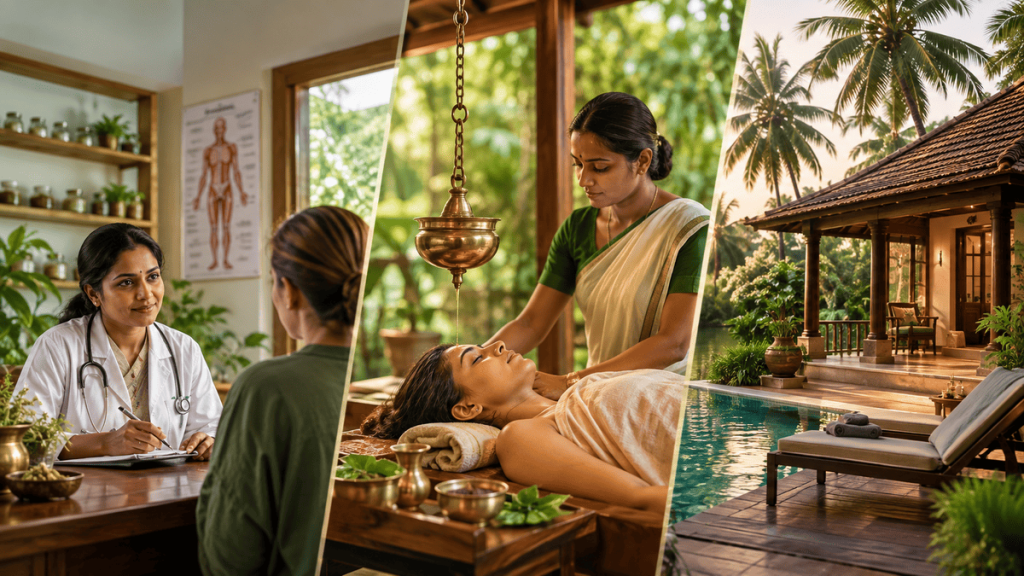
You decide you want to experience Ayurveda in Kerala.
So you open Google and start searching.
Within ten minutes, you have an Ayurveda hospital open in one tab, a beachside wellness resort in another, a traditional treatment centre somewhere in the hills, and an Instagram Reel showing somebody having oil poured over their forehead while birds sing in the background.
They all seem to offer Ayurveda.
They definitely don’t all offer the same experience.
This is one of the easiest things to misunderstand when planning an Ayurveda trip to Kerala. Words such as hospital, clinic, treatment centre, retreat and wellness resort are sometimes used quite loosely online, and the difference matters.
If you’re travelling from Europe, returning home as an NRI, visiting Kerala alone or planning a longer wellness stay, choosing the type of centre can be just as important as choosing the centre itself.
So, before you book that 14-day package, here’s what you should know.
Ayurveda Hospital: Usually the More Treatment-Focused Option
When you hear the word hospital, don’t automatically picture a conventional general hospital with emergency departments, operating theatres and busy corridors.
An Ayurveda hospital is built around the Ayurveda system of medicine.
The experience can vary considerably between facilities, but an Ayurveda hospital will generally place greater emphasis on consultations, structured care, practitioner involvement and treatment facilities than a holiday-focused wellness property.
India’s National Accreditation Board for Hospitals & Healthcare Providers (NABH) has a dedicated accreditation programme for AYUSH hospitals, including Ayurveda hospitals. Its standards cover areas such as quality and safety, documented procedures, trained practitioners and patient rights. (NABH)
That distinction matters if your main reason for travelling is not simply relaxation.
Perhaps you’ve already been advised to consider a longer Ayurveda programme. Maybe you’re an NRI spending several weeks in Kerala and want regular consultations. Or you may be travelling specifically to meet an Ayurveda practitioner rather than adding two treatments to a beach holiday.
In situations like those, an Ayurveda hospital may be worth considering.
The accommodation might be simpler than what you’d find in a luxury resort.
The surroundings may be less Instagram-friendly.
That doesn’t necessarily make it a worse choice.
You’re simply paying for a different kind of experience.
What Might an Ayurveda Hospital Stay Feel Like?
A hospital-based programme will usually feel more structured than a casual wellness stay.
There may be an initial consultation, followed by a programme that is adjusted according to the practitioner’s assessment. Depending on the hospital and your reason for attending, you may also have follow-up consultations while you’re there.
Some Ayurveda hospitals have inpatient accommodation, while others may operate more like outpatient facilities.
This is why you shouldn’t assume that the word hospital tells you everything.
Ask whether accommodation is available. Ask about meals. Find out how often you meet the practitioner and what happens outside treatment hours.
If you’re coming from abroad, ask who coordinates international patients and what support is available in English.
The medical side might be exactly what you’re looking for, but you still need somewhere comfortable to sleep for two or three weeks.
Ayurveda Centre: The Broadest Category of All
This is where things can become confusing.
An Ayurveda centre can mean quite a lot of different things.
One centre might operate as a small outpatient clinic where local patients come for consultations and therapies.
Another might have several treatment rooms, doctors, residential accommodation, food and programmes lasting several weeks.
Another may sit inside a hotel.
So if you see Ayurveda Centre in the name, don’t try to work out the entire business model from those two words.
Look deeper.
Kerala Tourism maintains information on accredited Ayurveda service providers across the state, and its classification system assesses Ayurveda units against prescribed requirements and facilities. Kerala Tourism’s current classification framework includes Ayur Silver, Ayur Gold and Ayur Diamond statuses, introduced to replace the older Olive Leaf and Green Leaf categories, although existing classifications can continue until their certificates expire. (Kerala Tourism)
That makes official classification one useful thing to look for when comparing providers, although it shouldn’t be the only thing you consider.
What matters most is understanding what a particular centre actually offers.
Who Is an Ayurveda Centre Best For?
An Ayurveda centre can work particularly well when you don’t need the full experience of a residential resort.
Imagine you’re an NRI staying with family in Ernakulam for six weeks.
You already have accommodation. Your meals are sorted. You don’t need sunset yoga beside an infinity pool.
You may simply want a qualified practitioner nearby, consultations and scheduled therapies.
A local treatment centre could make far more sense than paying for a residential package.
The same applies to someone spending several months in Kerala.
If you’re considering settling here, retiring here or returning after years abroad, access to a good local healthcare and wellness network can matter more than the experience of staying at a retreat.
This is an important distinction.
Tourists often choose a destination. Residents choose something they can realistically return to.
Wellness Resort: Ayurveda With a Holiday Around It
Now we move to the other end of the spectrum.
A wellness resort generally puts much more emphasis on the whole stay.
Yes, Ayurveda may be part of it.
But so might a lovely room, swimming pool, yoga classes, meditation, healthy meals, gardens, views, nature walks and a schedule designed to help you switch off from normal life.
For plenty of people, that’s exactly what they want.
If you’re flying from Ireland in the middle of February after several months of grey skies, spending two weeks somewhere surrounded by coconut trees while somebody else cooks your meals doesn’t sound particularly terrible.
A wellness resort can be especially attractive to international visitors who want Ayurveda to be part of a wider Kerala experience rather than the sole reason for travelling.
The key is understanding that wellness and medical treatment are not interchangeable.
A gorgeous resort may provide an excellent wellness experience without being the right setting for somebody looking for more clinically structured care.
On the other hand, somebody who mainly wants rest, yoga and a gentle introduction to Ayurveda may have no need to stay in a hospital environment.
Choose according to your purpose.
And What Exactly Is an Ayurveda Retreat?
Retreat is another word you’ll see everywhere.
It usually describes the experience more than the legal or clinical status of the provider.
A retreat might be a dedicated wellness property offering Ayurveda and yoga. It could be part of a resort. It could have practitioners on site. It could run scheduled programmes several times per year.
Some retreats focus heavily on Ayurveda.
Others combine a little Ayurveda with yoga, meditation, plant-based food, mindfulness and other wellness activities.
That’s why the phrase Ayurveda retreat shouldn’t automatically be interpreted as Ayurveda hospital.
The question to ask isn’t:
“Is this a retreat?”
It’s:
“Who provides the Ayurveda care here, and how is the programme actually organised?”
Hospital vs Centre vs Resort: Which Is Better?
None of them.
That’s the slightly annoying but useful answer.
A hospital isn’t automatically better because it sounds more serious.
A five-star resort isn’t automatically better because it costs more.
And a small Ayurveda centre isn’t automatically less authentic because it doesn’t have twenty acres of tropical gardens.
The right choice depends on why you’re going to Kerala in the first place.
If your priority is structured practitioner-led care, you may lean towards a hospital or treatment-focused centre.
If you’re staying with relatives or living locally, an outpatient centre or clinic may make far more sense.
If you’re mainly travelling for rest, wellness and an introduction to Ayurveda, a resort or retreat may suit you beautifully.
And sometimes the right provider sits somewhere between those categories.
That’s why it’s worth looking beyond the label.
Don’t Confuse Luxury With Quality of Care
This is one of the biggest traps when researching Ayurveda online.
Hospitality is easy to photograph.
Clinical quality isn’t.
A photographer can show you a gorgeous bedroom, an infinity pool, polished brass lamps, folded towels and a treatment room surrounded by flowers.
It’s much harder to put practitioner judgement, hygiene processes, record keeping or appropriate treatment decisions into an Instagram carousel.
So don’t use price or luxury as a shortcut for deciding whether the Ayurveda side is good.
There’s nothing wrong with wanting somewhere beautiful.
If I’m going away for three weeks, I’d rather have a pleasant room too.
Just evaluate the two things separately.
Ask yourself:
Do I like the accommodation?
Then ask:
Am I comfortable with the people responsible for the Ayurveda programme?
You need both answers if you’re booking a long residential stay.
Europeans Often Need More Than the Treatment Itself
If you’re travelling from Germany, France, Ireland, the UK, the Netherlands, Scandinavia or elsewhere in Europe, you’re probably not popping into Kerala for an afternoon appointment.
It’s a substantial journey.
You might stay for two weeks, three weeks or longer.
That changes what matters.
A technically suitable treatment centre might still be completely wrong for you if you’re uncomfortable there after day three.
Think about the rest of your life during the stay.
Can you communicate properly with staff?
Can the centre accommodate your dietary requirements?
What is the room actually like?
Is Wi-Fi available?
Can you do laundry?
Can you walk outside the property?
How remote are you?
What happens if you need normal medical care unrelated to the Ayurveda programme?
How do you get back to the airport?
These aren’t glamorous questions.
They’re the questions you’ll care about once the novelty wears off.
NRIs Shouldn’t Automatically Buy the “International Package”
Returning Malayalis are another interesting group because they sit somewhere between local patient and international traveller.
You may live in Dubai, London, Dublin, Toronto or Melbourne but still have parents, siblings or a home in Kerala.
That gives you options.
If you’re staying with family for two months, you may not need to pay for an expensive residential wellness resort just because it’s marketed towards overseas guests.
A good clinic or Ayurveda centre near home may suit you better.
You’ll have access to family, your own food, familiar surroundings and local transportation.
On the other hand, you might specifically want to get away from everything for two weeks.
Fair enough.
After twenty years of relatives asking when you’re coming to visit them, disappearing into a retreat in Wayanad may actually be part of the treatment.
The point is to compare what you need, rather than automatically assuming that an international visitor belongs in an international package.
Solo Travellers Need to Think About the Social Side Too
Travelling alone to an Ayurveda retreat can be wonderful.
It can also be very quiet.
Some people dream about that.
Others discover on day four that they haven’t had a proper conversation with another human being since Tuesday.
If you’re travelling solo, particularly for a longer programme, ask what the atmosphere is like.
Do guests eat together or separately?
Are there yoga sessions?
Are there common areas?
Do people normally stay for several weeks?
Is the property close to a town?
Can you easily leave during free time?
A clinical Ayurveda hospital may provide exactly the treatment environment you’re looking for while offering very little of the social experience you’d get at a retreat.
Neither is wrong.
Know yourself.
If you’re comfortable spending plenty of time alone, a quiet setting may be ideal.
If you’re hoping to meet other travellers, look for a property where the wider guest experience supports that.
Solo Female Travellers: Look Beyond the Property Gates
The same basic travel planning applies here as anywhere else.
Research the actual location, not just the accommodation.
Check how you’ll arrive from the airport or railway station, particularly if your flight lands late.
Ask whether the centre organises transfers.
Find out whether staff are available around the clock or only at certain times.
See what’s within easy reach of the property.
A remote hillside retreat might be wonderfully peaceful during daylight hours and feel very different when you’re arriving alone at 11.30 at night.
There’s no need to become paranoid about travel.
Just plan the boring bits before you arrive.
Content Creators: A Wellness Resort May Suit You Better — But Ask First
Travel creators have slightly different needs again.
If you’re visiting Kerala to create content about wellness, Ayurveda or slow travel, a visually attractive resort or retreat may naturally make more sense than a treatment-focused hospital.
But please don’t assume that buying a room gives you unrestricted filming rights.
Ayurveda settings involve staff, practitioners and sometimes other guests receiving treatments.
Privacy matters.
Before arriving with a camera, tell the property what you’re doing.
Ask whether treatments can be recorded, whether staff are happy to appear, whether there are restricted areas and whether other guests can be kept out of your footage.
If you’re proposing a collaboration, be clear about that too.
Some Kerala wellness businesses actively want exposure to international audiences. Others may have little interest in influencer collaborations.
Either answer is fine.
Knowing before you arrive saves everyone a rather awkward conversation involving a tripod and somebody holding a bowl of oil.
What About Panchakarma?
Panchakarma is one of the terms most international travellers encounter while searching for Ayurveda.
You may see it advertised by hospitals, Ayurveda centres and wellness resorts.
Don’t assume the experience is identical just because the same word appears in the package title.
The programme may differ depending on the practitioner, the provider and the individual.
If Panchakarma is the main reason you’re travelling, ask who assesses your suitability, who supervises the programme, what the proposed duration is and what preparation or follow-up may be involved.
And don’t choose a provider purely because its website says 21-Day Authentic Panchakarma in very large gold letters.
Good typography isn’t a medical credential.
Accreditation: What Should You Look For?
This is one area where doing a little homework is worthwhile.
Kerala Tourism publishes details of accredited Ayurveda service providers and operates a classification system for Ayurveda tourism units. Its newer framework uses Ayur Silver, Ayur Gold and Ayur Diamond categories, while some providers may still display valid older Green Leaf or Olive Leaf classifications during the transition. (Kerala Tourism)
At the healthcare level, NABH also operates an accreditation programme specifically for AYUSH hospitals, including Ayurveda facilities. NABH says its programme covers quality and safety aspects of care and is run in association with India’s Ministry of AYUSH. (NABH)
You don’t need to become an accreditation expert before going on holiday.
But if a provider says it’s officially accredited or classified, you can ask who issued that recognition and verify it where possible.
That’s far more useful than being impressed by a random badge on the footer of a website.
What About Existing Medical Conditions?
This deserves a clear answer.
If you have an existing medical condition, take prescription medication, are pregnant, have recently had surgery or are receiving ongoing medical treatment, don’t make major changes to that care simply because you’re beginning an Ayurveda programme.
Discuss your circumstances with the appropriate healthcare professionals.
Ayurvedic products and treatments are not automatically risk-free simply because they are described as traditional or natural. The US National Center for Complementary and Integrative Health notes that some Ayurvedic preparations can contain metals and that evidence for effectiveness varies depending on the condition being discussed. (NCCIH)
A responsible provider should want to know about relevant medication and health conditions before recommending a programme.
If someone promises to cure a serious illness before they’ve even properly assessed you, that should make you more cautious, not more excited.
What Should You Ask Before Booking?
You don’t need a forty-question interrogation.
A straightforward conversation can reveal a lot about a provider.
Before sending a substantial deposit, I’d want clear answers to these questions:
- Who conducts my initial consultation, and what are their qualifications?
- Is my programme decided after consultation or fixed in advance?
- What exactly is included in the quoted price?
- Are medicines, meals and accommodation included?
- How often will I meet the practitioner?
- What room will I actually be staying in?
- Are there additional charges I should expect?
- How far is the property from the airport and nearest hospital?
- Is airport transfer available?
- Can dietary requirements be accommodated?
- What is the cancellation policy?
- What happens if the programme needs to change?
- Is follow-up available after I leave Kerala?
- If I’m travelling alone, who can I contact if I need assistance?
You can learn almost as much from how a business answers as from the answers themselves.
Clear, patient communication before you’ve paid is a good sign.
Vague answers, pressure and constant demands for immediate deposits deserve more caution.
So, Which Type Should You Choose?
Think about your trip in plain language.
If you’re saying:
“I’m travelling primarily because I want structured Ayurveda care and practitioner supervision.”
Start by exploring Ayurveda hospitals and treatment-focused centres.
If you’re saying:
“I’m staying with family in Kerala and want consultations and treatments nearby.”
An outpatient Ayurveda centre or clinic may be the practical choice.
If you’re saying:
“I want to spend two weeks slowing down, practising yoga, eating well and experiencing Ayurveda as part of a wellness holiday.”
A residential wellness retreat or resort may suit you better.
If you’re saying:
“I’m travelling solo and want Ayurveda but also somewhere comfortable where I can meet other people.”
Look carefully at the wider retreat experience, not just the treatment menu.
And if you’re saying:
“I’m a travel creator coming to Kerala to experience and document wellness.”
A creator-friendly resort or retreat may make sense, provided you’ve discussed filming and collaboration beforehand.
Different person.
Different trip.
Different answer.
The Best Ayurveda Experience Isn’t Necessarily the Most Famous One
It’s tempting to search for “best Ayurveda centre in Kerala” and hand the decision over to Google.
The problem is that best doesn’t tell us much.
Best for whom?
A German traveller spending €4,000 on a three-week wellness escape?
An NRI staying at their parents’ house in Thrissur?
A solo backpacker travelling around Kerala for a month?
Someone looking for a structured Ayurveda programme?
A retired couple considering spending every winter in Kerala?
Their priorities aren’t remotely identical.
So instead of asking:
“Which is the best Ayurveda centre?”
Ask:
“Which type of Ayurveda provider is right for what I actually need?”
That’s a much better place to start.
Discover Ayurveda Providers Across Kerala With BloomVE
Kerala has everything from small local Ayurveda clinics to residential hospitals and destination wellness retreats.
BloomVE helps you discover these businesses, understand the services they offer and contact providers directly before planning your visit.
Whether you’re travelling from Europe, returning home as an NRI, exploring Kerala alone or looking for Ayurveda closer to where you live, compare your options before you book.
Explore Ayurveda & Wellness Providers on BloomVE →
Own an Ayurveda Hospital, Centre or Wellness Retreat?
Travellers don’t always understand the difference between the various Ayurveda options available in Kerala.
Your BloomVE profile is an opportunity to make it clear.
Show potential visitors what type of facility you operate, where you’re located, what services you provide and how they can contact you.
International travellers may begin researching months before they arrive. NRIs often compare providers before travelling home. Solo travellers want reassurance about accommodation and location. Wellness creators may be searching for experiences and businesses open to collaboration.
Help the right people find you.
List Your Business on BloomVE →
Get discovered. Get enquiries. Grow your business.
Frequently Asked Questions
Is an Ayurveda hospital better than an Ayurveda resort?
Not automatically. They are designed for different needs. An Ayurveda hospital will generally place more emphasis on structured healthcare and practitioner-led services, while a resort usually puts greater emphasis on accommodation and the overall wellness experience. The right choice depends on why you’re visiting.
What is the difference between an Ayurveda centre and an Ayurveda hospital?
An Ayurveda centre is a broad term and can describe anything from a small outpatient facility to a larger centre offering residential programmes. An Ayurveda hospital typically has a more formal healthcare structure. Always check the actual services and credentials of the individual provider rather than relying on its name alone.
Is a wellness resort the same as an Ayurveda treatment centre?
No. A wellness resort may offer Ayurveda alongside accommodation, yoga, meditation, food and leisure activities. A treatment-focused Ayurveda centre may place much greater emphasis on consultations and therapies and may not provide resort-style facilities.
Does Kerala officially classify Ayurveda centres?
Yes. Kerala Tourism provides information about accredited Ayurveda service providers and currently uses Ayur Silver, Ayur Gold and Ayur Diamond classifications under its newer classification scheme. Some providers may still show older Green Leaf or Olive Leaf classifications while existing certificates remain valid. (Kerala Tourism)
What does NABH accreditation mean for an Ayurveda hospital?
NABH operates an accreditation programme for AYUSH hospitals, including Ayurveda hospitals. The programme assesses quality and patient-safety-related standards, processes and systems. (NABH)
Which type is best for international travellers?
It depends on your reason for travelling. Someone seeking a relaxing residential wellness experience may prefer a resort or retreat. Someone travelling specifically for a structured programme may place greater importance on an Ayurveda hospital or treatment-focused centre.
Are Ayurveda retreats suitable for solo travellers?
They can be. Before booking, check the location, accommodation, transportation, meal arrangements, staff availability and whether there are communal activities if meeting other guests matters to you.
Can NRIs use local Ayurveda clinics instead of staying at a retreat?
Certainly. If you already have accommodation in Kerala, a nearby outpatient centre or clinic may be considerably more practical than paying for a residential package.
Can travel influencers film inside Ayurveda centres?
Never assume so. Ask the provider before filming treatments, staff, practitioners or other guests. Healthcare and wellness environments can involve privacy considerations that ordinary tourist attractions don’t.
Where can I find Ayurveda hospitals, centres and wellness retreats in Kerala?
BloomVE helps travellers and residents discover Ayurveda and wellness businesses across Kerala and contact providers directly to learn more about their services.